spring-boot: @Async annotation breaks Trace continuity
Spring Boot: 3.0.3
Using method with @Async annotation causes that Trace context is broken and spans within Async method are not child for outer spans.
Regarding this guide: https://github.com/micrometer-metrics/tracing/wiki/Spring-Cloud-Sleuth-3.1-Migration-Guide#async-instrumentation it should be working when declaring specific ThreadPoolTaskScheduler. But even with it, it is not working as expected. Sample test:
package com.example;

import io.micrometer.context.ContextExecutorService;
import io.micrometer.context.ContextSnapshot;
import io.micrometer.tracing.Span;
import io.micrometer.tracing.Tracer;
import org.junit.jupiter.api.Test;
import org.springframework.beans.factory.annotation.Autowired;
import org.springframework.boot.autoconfigure.EnableAutoConfiguration;
import org.springframework.boot.autoconfigure.SpringBootApplication;
import org.springframework.boot.test.autoconfigure.actuate.observability.AutoConfigureObservability;
import org.springframework.boot.test.context.SpringBootTest;
import org.springframework.context.annotation.Bean;
import org.springframework.context.annotation.Configuration;
import org.springframework.core.task.SimpleAsyncTaskExecutor;
import org.springframework.scheduling.annotation.Async;
import org.springframework.scheduling.annotation.AsyncConfigurer;
import org.springframework.scheduling.annotation.EnableAsync;
import org.springframework.scheduling.concurrent.ThreadPoolTaskScheduler;
import org.springframework.stereotype.Component;
import org.springframework.web.bind.annotation.RestController;
import org.springframework.web.servlet.config.annotation.AsyncSupportConfigurer;
import org.springframework.web.servlet.config.annotation.WebMvcConfigurer;

import java.util.concurrent.*;

import static org.springframework.boot.test.context.SpringBootTest.WebEnvironment.RANDOM_PORT;

@AutoConfigureObservability
@SpringBootTest(classes = {AsyncTracingTest.AsyncTracingTestApplication.class}, webEnvironment = RANDOM_PORT, properties = {
        "spring.cloud.gcp.trace.enabled=true",
        "spring.cloud.gcp.core.enabled=true",
        "spring.cloud.gcp.trace.project-id=xyz-project-id"
})
class AsyncTracingTest {
    @Autowired
    Tracer tracer;

    @Autowired
    AsyncTracingTestApplication.AsyncLogic asyncLogic;

    @Test
    void asyncTracingTest() {
        Span firstSpan = tracer.nextSpan().name("First span").tag("test", "test");
        try (Tracer.SpanInScope scope = this.tracer.withSpan(firstSpan.start())) {
            asyncLogic.asyncCall();
        }
        finally {
            firstSpan.end();
        }
    }

    @EnableAsync
    @SpringBootApplication(scanBasePackages = {"scanThisClassOnly"})
    @Configuration(proxyBeanMethods = false)
    static class AsyncTracingTestApplication {

        @Configuration(proxyBeanMethods = false)
        static class AsyncConfig implements AsyncConfigurer, WebMvcConfigurer {
            @Override
            public Executor getAsyncExecutor() {
                return ContextExecutorService.wrap(Executors.newCachedThreadPool(), ContextSnapshot::captureAll);
            }

            @Override
            public void configureAsyncSupport(AsyncSupportConfigurer configurer) {
                configurer.setTaskExecutor(new SimpleAsyncTaskExecutor(r -> new Thread(ContextSnapshot.captureAll().wrap(r))));
            }
        }

        @Bean(name = "taskExecutor", destroyMethod = "shutdown")
        ThreadPoolTaskScheduler threadPoolTaskScheduler() {
            ThreadPoolTaskScheduler threadPoolTaskScheduler = new ThreadPoolTaskScheduler() {
                @Override
                protected ExecutorService initializeExecutor(ThreadFactory threadFactory, RejectedExecutionHandler rejectedExecutionHandler) {
                    ExecutorService executorService = super.initializeExecutor(threadFactory, rejectedExecutionHandler);
                    return ContextExecutorService.wrap(executorService, ContextSnapshot::captureAll);
                }
            };
            threadPoolTaskScheduler.initialize();
            return threadPoolTaskScheduler;
        }

        @Component
        class AsyncLogic {
            Tracer tracer;

            public AsyncLogic(Tracer tracer) {
                this.tracer = tracer;
            }

            @Async("taskExecutor")
            public void asyncCall() {
                tracer.nextSpan().name("Second span").tag("test", "test").start().end();
            }
        }
    }
}
It results in 2 separate traces for First and Second spans:

After removing @Async annotation it is working as expected for synchronous call:

On Spring Boot 2.X with Sleuth it was working as continue trace (with additional span for async call). Sample test:
package com.example;

import org.junit.jupiter.api.Test;
import org.springframework.beans.factory.annotation.Autowired;
import org.springframework.boot.autoconfigure.EnableAutoConfiguration;
import org.springframework.boot.autoconfigure.SpringBootApplication;
import org.springframework.boot.test.context.SpringBootTest;
import org.springframework.cloud.sleuth.Span;
import org.springframework.cloud.sleuth.Tracer;
import org.springframework.context.annotation.Bean;
import org.springframework.context.annotation.Configuration;
import org.springframework.core.task.SimpleAsyncTaskExecutor;
import org.springframework.scheduling.annotation.Async;
import org.springframework.scheduling.annotation.AsyncConfigurer;
import org.springframework.scheduling.annotation.EnableAsync;
import org.springframework.scheduling.concurrent.ThreadPoolTaskScheduler;
import org.springframework.stereotype.Component;
import org.springframework.web.servlet.config.annotation.AsyncSupportConfigurer;
import org.springframework.web.servlet.config.annotation.WebMvcConfigurer;

import java.util.concurrent.*;

import static org.springframework.boot.test.context.SpringBootTest.WebEnvironment.RANDOM_PORT;

@SpringBootTest(classes = {AsyncTracingTest.AsyncTracingTestApplication.class}, webEnvironment = RANDOM_PORT, properties = {
        "spring.cloud.gcp.trace.enabled=true",
        "spring.cloud.gcp.core.enabled=true",
        "spring.cloud.gcp.trace.project-id=xyz-project-id"
})
class AsyncTracingTest {
    @Autowired
    Tracer tracer;

    @Autowired
    AsyncTracingTestApplication.AsyncLogic asyncLogic;

    @Test
    void asyncTracingTest() {
        Span firstSpan = tracer.nextSpan().name("First span").tag("test", "test");
        try (Tracer.SpanInScope scope = this.tracer.withSpan(firstSpan.start())) {
            asyncLogic.asyncCall();
        }
        finally {
            firstSpan.end();
        }
    }

    @EnableAsync
    @SpringBootApplication(scanBasePackages = {"scanThisClassOnly"})
    @Configuration(proxyBeanMethods = false)
    static class AsyncTracingTestApplication {

        @Component
        class AsyncLogic {
            Tracer tracer;

            public AsyncLogic(Tracer tracer) {
                this.tracer = tracer;
            }
            @Async("taskExecutor")
            public void asyncCall() {
                tracer.nextSpan().name("Second span").tag("test", "test").start().end();
            }
        }
    }
}
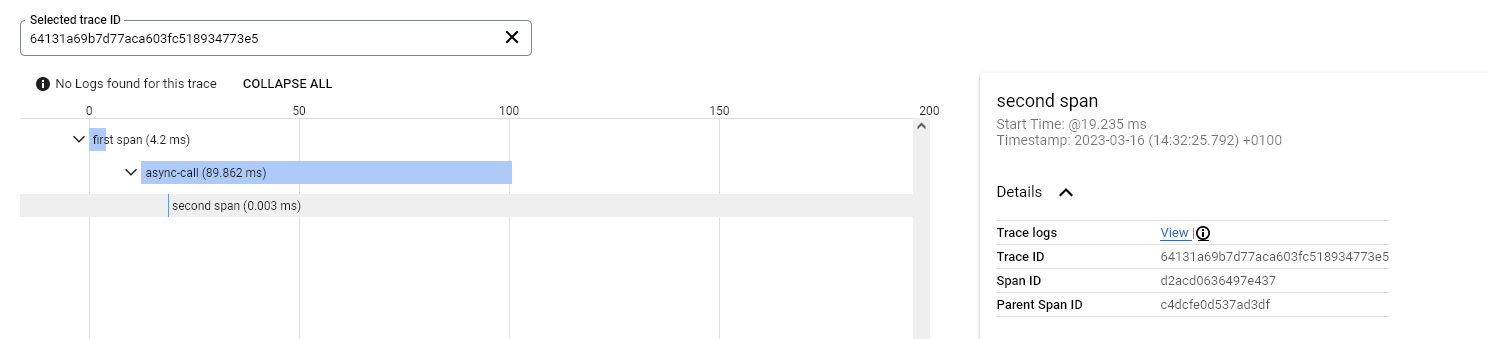
For me it seems like a bug with @Async handling.
E.g. for AsyncTaskExecutor
Callable<String> tracedCallable = tracer.currentTraceContext().wrap(callable);
threadPoolTaskExecutor.submit(tracedCallable);
it correctly passes Tracing context to asynchronous callable.
About this issue
- Original URL
- State: closed
- Created 4 years ago
- Comments: 16 (7 by maintainers)
@bylidev what gives you the impression that we don’t like this use case?
The workaround you have shared is not advised as it wraps the original type as
ExecutorServiceand erases the concrete typeThreadPoolTaskExecutor. Exposing the most concrete type in the bean method signature is the preferred approach in Spring applications.Setting up context propagation by default for all executors would create significant overhead, even if the use case doesn’t require it. You can check out Spring Framework’s reference documentation on observability for application events and executors for a simpler solution.
There were various problems after upgrading from Spring Cloud Sleuth to Micrometer Tracing. Using Spring Cloud Sleuth only requires a simple configuration, and switching to Micrometer Tracing makes me very upset.
Thank you @rafal-dudek for filing this issue and for a great reproducer.
Missing Wiki Entry
To begin with we’re missing wrapping of the
ScheduledExecutorServicein the wiki migration guide snippet (I’ve already updated the wiki page).Making This Work With Current Setup
Adding that snippet won’t help you out fully just yet. In order for this to work out of the box, you would need to change your code to use observations as presented below:
If you do that you will observe that the ids got propagated.
Making This Work With Micrometer Tracing API
However there should be no problem with actually using just the Micrometer Tracing API and assuming that things just work. So let me suggest a temporary workaround for you until we figure out a better way of doing things.
What we will need is a Micrometer Tracing
ThreadLocalAccessorthat will be aware ofObservations. You can use this code:Having that you need to register it in your code. You can do it by calling the Context Propagation API like this
Test Code
With that done tracing context will be propagated regardless of the fact whether you’re using Observation API and / or Tracing API. Let me paste the whole testing code:
Summary
WDYT about this? I’ve checked this code and it works fine, if that’s possible, could you please check it also on your side @rafal-dudek ?
I’ve created an issue in Micrometer Tracing to track this https://github.com/micrometer-metrics/tracing/issues/206.
Solved adding task decorator as well, thanks !
executor.setTaskDecorator(new ContextPropagatingTaskDecorator());@marcingrzejszczak Will this work in Spring Boot 3.2.2 with virtual threads?
Yes it is working, didn’t thought to check that. So I am waiting for https://github.com/micrometer-metrics/tracing/issues/206. Thanks
Thanks, with ScheduledExecutorService override and using Observation instead of Span tracing for
@Asyncis working properly.I also checked your ObservationAwareSpanThreadLocalAccessor and it is working for Spans without Observation.
I’m looking forward to more automatic way to do that in some future Spring Boot update, as it might be convenient for our teams.