NetFabric.Hyperlinq: Experiencing Slow ArrayPool Performance with Enumerables
Please see the SLN found here:
https://github.com/Mike-E-angelo/Stash/tree/master/Hyperlinq.Memory
When running the tests, I see the following:
|              Method |      Mean |    Error |   StdDev |  Gen 0 | Gen 1 | Gen 2 | Allocated |
|-------------------- |----------:|---------:|---------:|-------:|------:|------:|----------:|
|      LinqEnumerable |  28.76 ns | 0.242 ns | 0.226 ns | 0.0038 |     - |     - |      32 B |
| HyperlinqEnumerable | 164.11 ns | 3.246 ns | 4.656 ns | 0.0038 |     - |     - |      32 B |
|     BasicEnumerable |  64.24 ns | 1.303 ns | 1.219 ns | 0.0038 |     - |     - |      32 B |
|           LinqArray |  30.62 ns | 0.479 ns | 0.400 ns | 0.0038 |     - |     - |      32 B |
|      HyperlinqArray |  44.31 ns | 0.663 ns | 0.620 ns |      - |     - |     - |         - |
|          BasicArray |  66.51 ns | 0.699 ns | 0.620 ns | 0.0038 |     - |     - |      32 B |
You can see that HyperlinqEnumerable seems abnormally slow. It is a copy/paste of HyperlinqArray but uses an IEnumerable<int> instead of an int[].
Wanted to bring this up in case it’s not a known issue. Or if I have something fundamentally misunderstood. 😃
About this issue
- Original URL
- State: closed
- Created 3 years ago
- Comments: 16 (8 by maintainers)
Commits related to this issue
- Fix Contains() and ToArray() #373 — committed to NetFabric/NetFabric.Hyperlinq by aalmada 3 years ago
- Fix Contains() and ToArray() (#376) * Fix Contains() and ToArray() #373 * Fix Contains() with custom IEqualityComparer<> — committed to NetFabric/NetFabric.Hyperlinq by aalmada 3 years ago
Awesome! Thank you for your efforts, @aalmada!
Today I was thinking a bit more about
Contains()and realized I don’t need the source generator to fix the issue with your case.Contains()is very confusing because it’s both a LINQ method and anICollection<>method. I have to be very careful not to create infinite call loops. I have already written so many versions of it that I lost count. I sure hope this is the last time. 😉Contains()ToArray()performance is about the same with and withoutArrayPool.Much more acceptable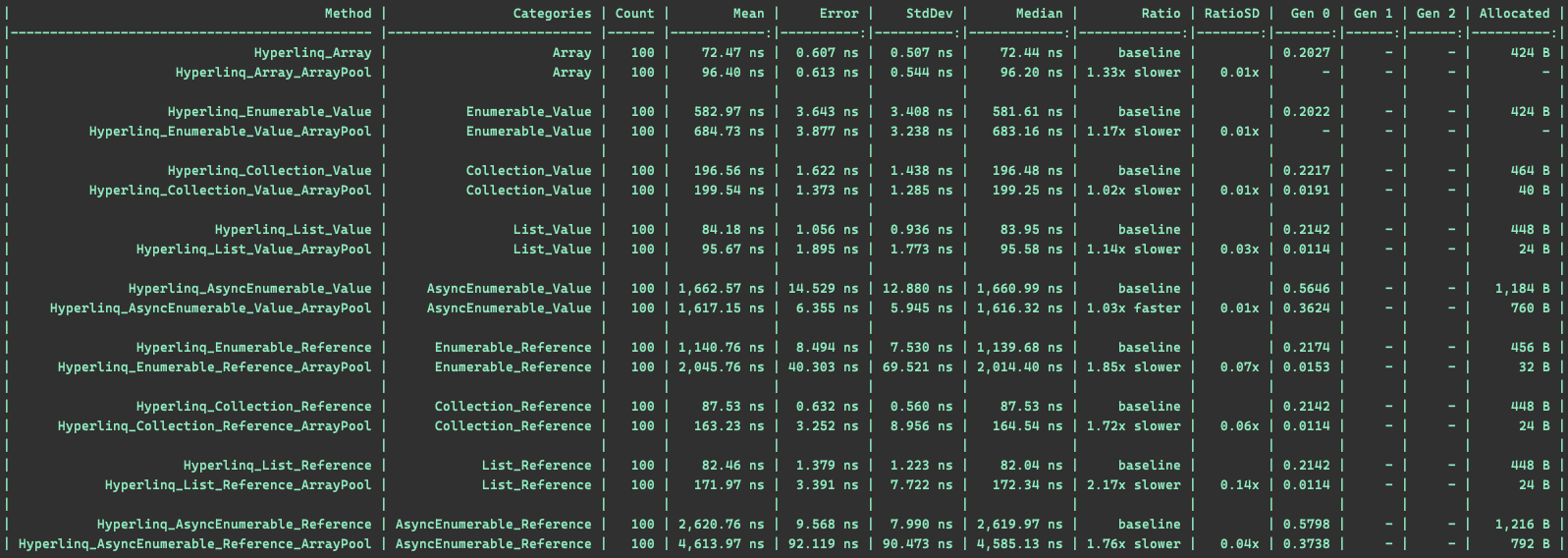
Hah no worries there are only a million billion things going on with what we do here. 😃 I am amazed that I am able to keep as many details straight that I do, personally. It’s sort of the name of the game, TBH. And FWIW my intent is not to point out that a possible mistake was made (an attitude that seems to be rampant in dev culture) but to ensure my understanding and that I am following along correctly.
In any case, I am glad you are able to apply a fix. 👍
Right,
CopyTois occurring in Linq but not Hyperlinq. It’s not related to the source generator. It’s only related to the limitation on theCopyTodestination parameter but read what’s next…Damnit, you’re right once again. I feel so embarrassed… 😔
ArrayPool.Rent()does return an array. It’s my implementation ofValueMemoryOwner<>that returnsMemory<>.I implemented it this way because
ArrayPool.Rent()may return an array larger than requested. That requires some more work by the caller ofToArray()if this larger array was returned. I slice it using aMemory<>to make it simpler. I implementIMemoryOwner<>to make it similar toMemoryPool.Sorry, I got lost in these details and forgot about the return type of
ArrayPool.Rent().This means I can fix the issue.
CopyTocan be applied on the unsliced array and then return the sliced one.Thanks for insisting on this… 😞
Yes, you’re right. That shouldn’t happen. I now understand that it’s an issue with how
AsValueEnumerable()is implemented.I’ve been working on a total refactor of the source generator that will fix this issue and many more. I hope to release this other version soon.
Those 10x times slower can’t be the disposing. 🤪 I’m going to check what’s going on.
I now realized that I’m doing the benchmarking wrong.
The
ToArray()with anArrayPoolparameter returns aValueMemoryOwner<>that has to be disposed so that the rented memory is returned to the pool. To avoid dead code elimination and to make sure the dispose happens, just like you, I’m calculating the sum of the array items and disposing before returning the result of the sum.For the other
ToArray()benchmarks I was just returning the array because I’m only interested in benchmarking its creation. Not iterating on it.The issue is that, even if I calculate the sum for both, the dispose is still accounted for. Making the benchmarks still not really comparable.
I noticed a long time ago about this limitation and I’ve been wanting to report an issue but ended up never doing it. I finally did it. https://github.com/dotnet/BenchmarkDotNet/issues/1788
Let’s see what they say but, for now, I’ll work with what we have now.
OK, that makes sense now, @aalmada. I appreciate your time in investigating this as well as the time taken to explain your findings. Hopefully, you can track down the
ArrayPoolbandit. 😃 🤞For now, I run my benchmarks and got the following results:
ToArray()Contains()I now need to analyze the code to understand what’s going on with
ToArray()with theArrayPoolparameter.On the
Contains(), notice that it only allocates when it’s an enumerable and the enumerator is a reference type. That’s expected. The only way to enumerate it is by callingGetEnumerator()which created the instance. Any other operation appended will not have this penalty as the first operation returns anIValueEnumerable<,>for which theGetEnumerator()returns a value type.For the other enumerables, it calls the
ICollection<>.Contains(). This will allocate if the enumerable (not the enumerator) is a value type, which will be boxed.It will allocate an enumerator if it implements
IReadOnlyCollection<>but notICollection<>. Most collections implement both.Sorry, I didn’t notice you reported an issue. 😦 I’ll have to check what’s going on. Thanks for reporting it.