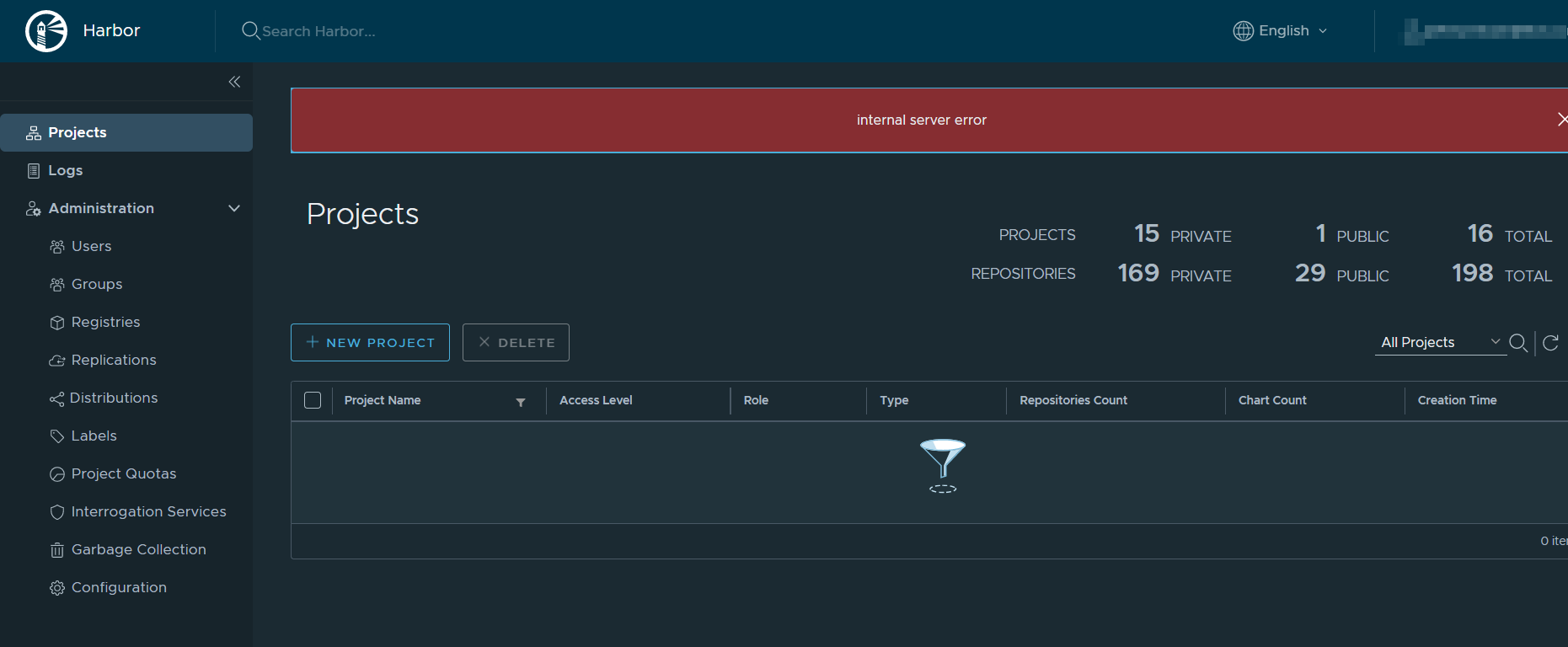
harbor: Harbor Projects Are Very Slow to Load
I wonder if maybe I have a misconfig somewhere or need to allocate more resources or enable a caching mechanism because when I go to the projects view it takes a long time to load. First it takes a long time to load the list of projects at /harbor/projects/ then when I click my projects and go to respositories e.g. /projects/2/repositories/ or helm charts e.g. /projects/2/helm-charts/.
Load times: 23.15s for main projects page: /harbor/projects/ 20.96s for clicking through to my project: /projects/2/repositories/ 21.33s for clicking through to my chart repo: /projects/2/repositories/
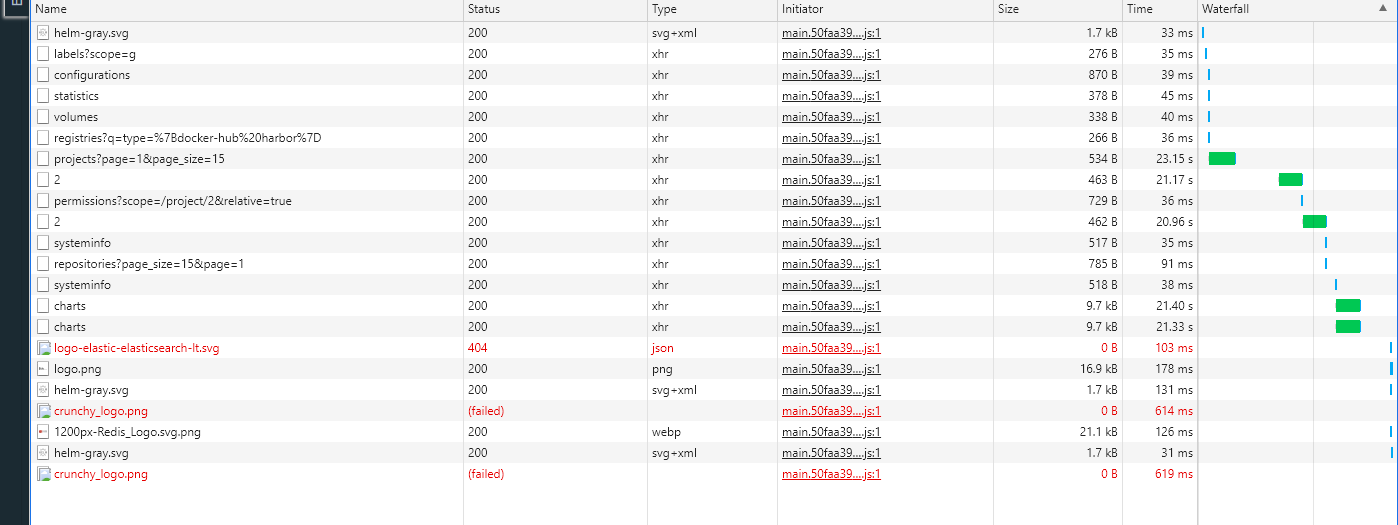
The main project has 335 Repositories and 366 Helm Charts.
Any idea how I can increase performance here?
Here are my chart values:
chartmuseum:
  absoluteUrl: false
  enabled: true
  image:
    repository: goharbor/chartmuseum-photon
    tag: v2.1.0
  nodeSelector:
    agentpool: stateful
  replicas: 1
clair:
  adapter:
    image:
      repository: goharbor/clair-adapter-photon
      tag: v2.1.0
  clair:
    image:
      repository: goharbor/clair-photon
      tag: v2.1.0
  enabled: true
  nodeSelector:
    agentpool: stateful
  replicas: 1
  updatersInterval: 12
core:
  image:
    repository: goharbor/harbor-core
    tag: v2.1.0
  nodeSelector:
    agentpool: stateful
  replicas: 1
  resources:
    requests:
      cpu: 300m
      memory: 8192Mi
  startupProbe:
    initialDelaySeconds: 10
database:
  internal:
    image:
      repository: goharbor/harbor-db
      tag: v2.1.0
    nodeSelector:
      agentpool: stateful
    password: censored
    resources:
      requests:
        cpu: 100m
        memory: 256Mi
    sslmode: disable
  maxIdleConns: 50
  maxOpenConns: 1000
  type: internal
expose:
  clusterIP:
    name: harbor
    ports:
      httpPort: 80
  ingress:
    annotations:
      ingress.kubernetes.io/proxy-body-size: 10000m
      ingress.kubernetes.io/ssl-redirect: "true"
      kubernetes.io/ingress.allow-http: "false"
      kubernetes.io/ingress.class: nginx
      kubernetes.io/tls-acme: "true"
      nginx.ingress.kubernetes.io/proxy-body-size: 10000m
      nginx.ingress.kubernetes.io/ssl-redirect: "true"
    controller: default
    hosts:
      core: harbor.x.com
  tls:
    certSource: secret
    enabled: true
    secret:
      notarySecretName: harbor.x.com
      secretName: harbor.x.com
  type: ingress
externalURL: https://harbor.x.com
harborAdminPassword: censored
imagePullPolicy: IfNotPresent
internalTLS:
  certSource: auto
  chartmuseum:
    crt: ""
    key: ""
    secretName: ""
  clair:
    crt: ""
    key: ""
    secretName: ""
  core:
    crt: ""
    key: ""
    secretName: ""
  enabled: false
  jobservice:
    crt: ""
    key: ""
    secretName: ""
  portal:
    crt: ""
    key: ""
    secretName: ""
  registry:
    crt: ""
    key: ""
    secretName: ""
  trivy:
    crt: ""
    key: ""
    secretName: ""
  trustCa: ""
jobservice:
  image:
    repository: goharbor/harbor-jobservice
    tag: v2.1.0
  jobLogger: stdout
  maxJobWorkers: 10
  replicas: 1
logLevel: debug
notary:
  affinity: {}
  enabled: false
  nodeSelector: {}
  podAnnotations: {}
  secretName: ""
  server:
    image:
      repository: goharbor/notary-server-photon
      tag: v2.1.0
    replicas: 1
    serviceAccountName: ""
  signer:
    image:
      repository: goharbor/notary-signer-photon
      tag: v2.1.0
    replicas: 1
    serviceAccountName: ""
  tolerations: []
persistence:
  enabled: true
  imageChartStorage:
    disableredirect: false
    gcs:
      bucket: harbor
      chunksize: "5242880"
      encodedkey: x
      rootdirectory: /
    type: gcs
  persistentVolumeClaim:
    chartmuseum:
      accessMode: ReadWriteOnce
      existingClaim: '-'
      size: 5Gi
      storageClass: ""
      subPath: ""
    database:
      accessMode: ReadWriteOnce
      existingClaim: ""
      size: 32Gi
      storageClass: fast
      subPath: ""
    jobservice:
      accessMode: ReadWriteOnce
      existingClaim: ""
      size: 8Gi
      storageClass: fast
      subPath: ""
    redis:
      accessMode: ReadWriteOnce
      existingClaim: ""
      size: 32Gi
      storageClass: fast
      subPath: ""
    registry:
      accessMode: ReadWriteOnce
      existingClaim: ""
      size: 5Gi
      storageClass: '-'
      subPath: ""
    trivy:
      accessMode: ReadWriteOnce
      existingClaim: ""
      size: 5Gi
      storageClass: fast
      subPath: ""
  resourcePolicy: keep
portal:
  image:
    repository: goharbor/harbor-portal
    tag: v2.1.0
  nodeSelector:
    agentpool: stateful
  replicas: 1
  resources:
    requests:
      cpu: 300m
      memory: 1Gi
proxy:
  components:
  - core
  - jobservice
  - clair
  - trivy
  httpProxy: null
  httpsProxy: null
  noProxy: 127.0.0.1,localhost,.local,.internal
redis:
  internal:
    image:
      repository: goharbor/redis-photon
      tag: v2.1.0
    nodeSelector:
      agentpool: stateful
    serviceAccountName: ""
  type: internal
registry:
  controller:
    image:
      repository: goharbor/harbor-registryctl
      tag: v2.1.0
  credentials:
    htpasswd: user_harbor:censored
    password: censored
    username: user_harbor
  middleware:
    enabled: false
  registry:
    image:
      repository: goharbor/registry-photon
      tag: v2.1.0
  relativeurls: false
  replicas: 1
secretKey: pass
trivy:
  affinity: {}
  debugMode: false
  enabled: true
  ignoreUnfixed: false
  image:
    repository: goharbor/trivy-adapter-photon
    tag: v2.1.0
  insecure: false
  nodeSelector: {}
  podAnnotations: {}
  replicas: 1
  resources:
    limits:
      cpu: 1
      memory: 1Gi
    requests:
      cpu: 200m
      memory: 512Mi
  severity: UNKNOWN,LOW,MEDIUM,HIGH,CRITICAL
  skipUpdate: false
  tolerations: []
  vulnType: os,library
updateStrategy:
  type: RollingUpdate
About this issue
- Original URL
- State: closed
- Created 4 years ago
- Reactions: 2
- Comments: 19 (3 by maintainers)
I did some debug log hunting, and it seems part of the problem is it runs a helm repo update to download the index yaml for chartmuseum for every call to ths project. This seems pretty inefficient. Maybe the index yaml can be cached to redis on each chart push and then read from there?
Could it be an option to move from 0.12.0 to the newer version 0.13.1 of chartmuseum? A performance problem in chartmuseum has been fixed already in version 0.13.0: Improve performance when dealing with thousands of charts
Another thing I noticed is that the index-cache.yaml stored in s3 bucket ( because my backend storage is s3 ), harbor never cleans up index.yaml after deleting a chart from harbor. This overtime makes the index.yaml huge and running a helm repo update on each call to the project on a large enough index.yaml slows operation down by a lot !
Running into the same issues with just 10 helm charts but several versions of each and 50 repos… this makes the UI unusable …
I think this should no longer be tagged as pending more info needed since the problem is clear as are the potential solutions. @ninjadq
So the problem is every single call to the project related endpoints forces a helm repo update call to chartmuseum to get a fresh index yaml instead of caching it. This means no matter how many charts you have it will cause problems. The solution would be to store the index yaml inside of redis and serve the index yaml that way then have a backend cron job or scheduled job with a configurable refresh timer to not have this call on every page load. This will solve everything while also making chartmuseum usable. Because using container registry storage for charts isn’t an option while it is still experimental.
Since upgrading to 2.1 we are seeing what appears to be the same issue. We only have a handful of helm charts (we are not using OCI with Helm 3 because it is still considered Experimental and we need to deliver Helm Charts to our end users). In some cases the main Project Page takes >30 seconds to load and once in a while ends with this: