xgboost: rank:ndcg does not work in Python
Hey,
rank:ndcg produces constant results, while rank:pairwise works as expected.
import numpy as np
import pandas as pd
import random
import xgboost as xgb

# creating some artificial ranking data

gsizes = [10, 100, 50]
params = [1, 2, 3]
relevances = []
features_1 = []
features_2 = []
qids = []
for gsize, param in zip(gsizes, params):

    range_ = list(range(gsize))
    random.shuffle(range_)

    relevances.extend(np.abs(np.random.randn(gsize)) + param*np.array(range_))
    feature_1 = np.array(range_)*param*2+14 + np.random.randn(gsize)
    feature_2 = np.array(range_)*param**2 + np.random.randn(gsize)**2
    features_1.extend(feature_1)
    features_2.extend(feature_2)
    qids.extend([param]*gsize)

ranker = xgb.XGBRanker(objective='rank:ndcg',
                       base_score=0.1,
                       verbosity = 1,
                       n_estimators=200)
inputs = np.array([features_1, features_2, qids]).T
fitted = ranker.fit(X=inputs , y=relevances, group=gsizes)
fitted.predict(inputs)[:10]

array([-0.9008925, -0.9008925, -0.9008925, -0.9008925, -0.9008925,
       -0.9008925, -0.9008925, -0.9008925, -0.9008925, -0.9008925],
      dtype=float32)
The results when I use pairwise:
fitted.predict(inputs)[:10]
array([-4.8152976 , -1.3937551 ,  0.36378622,  1.7936848 , -2.8243895 ,
       -9.020457  , -7.9117856 ,  3.2185328 , -7.152711  , -3.2654085 ],
      dtype=float32)
which has an NDCG of 1.
Environment: Python 3.7.6 xgboost 1.2.0
Best,
Pascal
About this issue
- Original URL
- State: closed
- Created 4 years ago
- Comments: 16 (8 by maintainers)
Hello, when fiddling with xgboost’s Python API on MacOS, I’ve noticed a peculiar behaviour.
If, using this data, I change the relevance labels 1 into 33, effectively introducing overflows in
NDCGLambdaWeightComputer::ComputeDeltaWeightand in IDCG calculation (rank_obj.cu file), rank:ndcg suddenly starts working OK, achieving NDCG@60 == 1.0 in the first iteration with default parameters, while rank:pairwise needs two iterations for the same result.However, if I place a
usleep(10)after thedeltacalculation (between L366 and L367 in rank_obj.cu), rebuild the lib and install the Python package, rank:ndcg works just as with labels < 32 (less than because 32 results in 0.0 IDCGs), achieving only 0.81546 after two iterations, while rank:pairwise gets 1.0. Originally, I placed aLOG(DEBUG)there to print the calculated weights but it turns out that anything somewhat time consuming is enough, ausleep(10), for example.This behaviour is not present on a Linux VM on Google Compute Engine and rank:ndcg’s behaviour is consistently worse than rank:pairwise throughout the positive label value range, with or without the
usleep(10).I’ve also noticed that, if not exploiting the overflow on Mac, somewhat unorthodox parameter choice can be made for rank:ndcg to perform on par with rank:pairwise in the attached example, e.g.
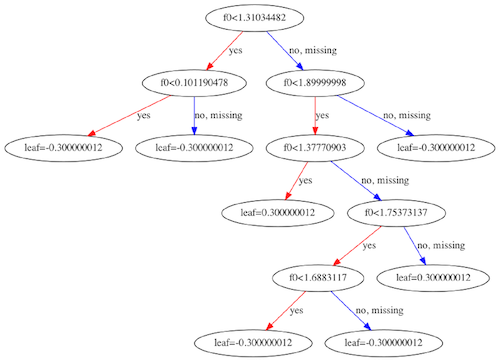
"min_child_weight": 0.0, "lambda": 0.0inparamsparameter ofxgb.train(...)function. Maybe it’s due to the considerably smaller gradients of rank:ndcg compared to rank:pairwise? When rank:ndcg works on par with rank:pairwise (intentional overflow on Mac or certainmin_child weightandlambdaparameter choice), the trees are much more complex than in the other case.Please find two example trees attached below - one is very simple and is a result of applying the default parameters and relevance labels. The more complex one is a result of the 2^label overflow but a similar tree is produced with particular parameter values.
The Python code I’m using:
Simple tree: Complex tree:
@trivialfis could you expand on that? I know it is common to have integer labels, but float labels should work as well.
Gain = 2 ^ rel_i - 1also works for real valued relevance scores.Related: https://github.com/dmlc/xgboost/issues/4177
Also @trivialfis any idea when the PR will be merged?
Yes. But I’m revising ndcg implementation and will submit a PR in this few days, which will be much simpler. So I suggest you to wait a bit. Will post the link to code later as I’m currently replying on phone.
Thanks for submitting the issue. Let me take a look tomorrow. The implementation involves sampling to reduce time complexity so might take some time to debug.